Lansing's Homeowner Permit Rule for Tagged Structures
Contents

"They had a lot of applicants coming in stating they were going to be the homeowner and they weren't, then doing the work and flipping them, without the construction knowledge."
Lansing Code Compliance, describing the rationale for the January 9, 2026 homeowner-permit policy to the Committee on Public Safety, April 2, 2026
LANSING, Mich. — On November 19, 2025, Tony Haddad sat at a make-safe-or-demolish hearing for his sister's house at 108 W. Barnes Avenue. The hearing officer, Dave Muylle, found the building dangerous under Michigan's Housing Law of 1917, MCL 125.539, substantially destroyed by fire, and ordered it made safe or demolished by January 20, 2026.
The house was not the kind that usually gets ordered demolished. Tony Haddad had lived there for eight or nine years by his own testimony to Council, and he had just finished remodeling; in his own words, "it was 99 percent done." An unhoused person sleeping on the porch lit a candle on a cold night and started a fire. The fire department put it out, then came back to cut holes in the ceilings and roof to confirm it was out. Haddad said the damage was smoke and water, plus the roof and some drywall. The City's Make Safe or Demolish Case Overview Sheet (April 20, 2026 City Council packet, p. 32) put the repair cost at $137,655.20, while Haddad estimated he could do the work himself for about $20,000. The $117,000 gap between those two numbers has not been resolved. If the City's number reflects structural damage the owner did not describe, the case for requiring licensed contractors is stronger than Haddad makes it sound. If the owner's number reflects the actual cosmetic scope, the opposite is true. That $117,000 question sits at the center of everything that follows.
At the November hearing, Haddad and the City worked out a path forward. The listed taxpayer was his sister, Linda Haddad, whose address is in Novi, so if Tony added his name to the title, the City said, he could pull a homeowner permit and fix the damage himself. He went home, added his name to the title, and went to the permit counter.
He was told he could not have the permit.
A rule that was not a law
Between November 19, 2025 and the day Tony Haddad walked into the permit counter, the City of Lansing Building Safety Office had issued a two-page policy titled "Building Safety Policy, Homeowner Permits for Tagged Unsafe Structures." It took effect on January 9, 2026. Building Official Jonathon Snyder signed it on the letterhead of the Department of Economic Development and Planning, Director Rawley Van Fossen. The Lansing City Council never voted on it.
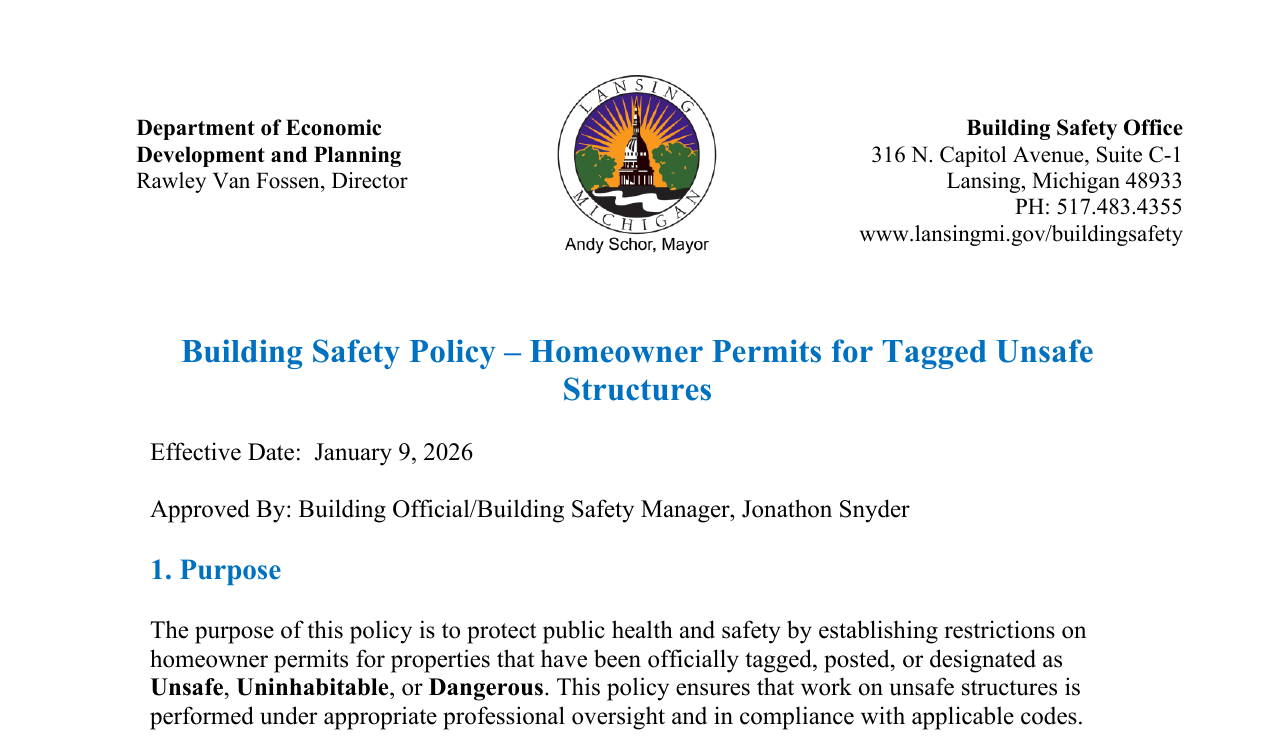
The rule itself is short. If someone buys or otherwise acquires a Lansing property that already carries an unsafe, uninhabitable, or dangerous designation, they can't pull a homeowner permit for repairs, alterations, or reconstruction. Any permitted work to fix the property has to go to a licensed contractor. The unsafe designation comes off only after those contractor-led repairs pass inspection. Once the designation is lifted, the owner can apply for homeowner permits again, if they're otherwise eligible.
The policy isn't posted on the City's Building Safety page or at the Permits page. A Wayback Machine search on April 22, 2026 returns no snapshot of the Building Safety URL anywhere in 2025. The document exists only as an internal memo in the Building Safety Office.
On April 2, 2026, Code Compliance staff described the policy verbally to the Committee on Public Safety (CivicClerk Event 8024). They told the committee the policy was written because "they had a lot of applicants coming in stating they were going to be the homeowner and they weren't, then doing the work and flipping them, without the construction knowledge." Council Member Peter Spadafore, the committee chair, asked for a copy of the policy on the record. As of the April 16, 2026 Committee on Public Safety meeting, no copy had been given to Council in writing. The April 2 minutes memorializing the exchange were approved on April 16.
What the rule does, and what it does not
The rule doesn't change who gets protected from a dangerous building or what work has to be done to remove a red tag. Under Michigan state law, specifically the Stille-Derossett-Hale Act of 1972, a homeowner can normally act as their own general contractor on their own house, and the Lansing rule doesn't take that authority away.
What it changes is who can hold the permit on a specific kind of property: a house that already has an unsafe or dangerous tag when the owner takes possession. On those houses, the homeowner counter is closed.
Before January 9, a Lansing homeowner could follow the familiar Michigan path into distressed-property ownership: buy cheap, fix it yourself, keep the equity. After January 9, on any Lansing property already carrying a red tag, that path is closed until a licensed contractor finishes the work that gets the tag lifted. The same homeowner, doing the same repair, is allowed at the counter on a non-tagged property and blocked at the counter on a tagged one.
What peer cities do
Other cities, including Detroit under the same Michigan rules, let homeowners do their own repairs on condemned property. Lansing's new rule doesn't.
Detroit is the closest comparison because it runs under the same Michigan building code as Lansing. Its Buildings, Safety, Engineering and Environmental Department lets homeowners pull permits for electrical, mechanical, and plumbing work on their own property, with proof of ownership and limits on the scope of work. Detroit's published FAQ doesn't specifically address condemned property, and that absence says something: Detroit hasn't adopted Lansing's kind of rule that closes the homeowner counter on condemned buildings, and its homeowner-permit path stays open at the counter.
Philadelphia runs under the International Property Maintenance Code, which is the same model code Lansing adopted through Ordinance 1460.01. Every Philadelphia property declared "imminently dangerous" needs a "Make Safe Permit." The Philadelphia rule, verified against the current Philadelphia Services page on April 22, 2026, reads: "A licensed Philadelphia contractor must perform the work except when the project involves an existing one-or-two-family home." On those homes, the same rule says the work may also be performed by "an owner who resides in the building."
In Cleveland, the Division of Code Enforcement's rule, verified against the current Cleveland page on April 22, 2026, reads: "Owner-occupants of one- or two-family homes may perform alterations or build homes without being registered as contractors but are subject to the same regulations that apply to contractors for permits, plan examination, and inspection." Owners of condemned property bring a rehab plan and a violation notice to the Department of Building and Housing, and work starts from there.
Michigan state law lets cities allow homeowner permits, but doesn't require them. The Building Official in any Michigan city can set counter practice within the code the city has adopted, and Lansing used that authority. Detroit, Philadelphia, and Cleveland chose differently: Detroit uses the same state code as Lansing, while Philadelphia and Cleveland use state codes that adopt the same model code Lansing did. Each of the three keeps the homeowner-repair path open on the exact kind of property Lansing's rule closes.
The policy's stated rationale and Tony Haddad's case do not match
The reason Code Compliance gave to the Committee on Public Safety on April 2 was aimed at a specific kind of person: applicants who pretend to be homeowners, who don't actually know how to do the construction they're pulling permits for, and who are flipping the property rather than living in it. That's a real concern. Investors posing as homeowners, pulling permits, and flipping houses is a documented problem in Michigan, and a rule that tries to stop it is defensible.
Tony Haddad told Council he is not that person, and the facts he put on the record run the other direction. By his own testimony, he has lived at 108 W. Barnes for eight or nine years, and he personally did the remodel that got the home to 99 percent done before the fire. The listed taxpayer is his sister, and he had added his name to the title as part of the deal worked out at the November make-safe-or-demolish hearing. The work he wanted to do, again by his description, was drywall, windows, minor framing, and interior electrical or plumbing within existing services. That kind of work is inside the homeowner-permit category every peer city keeps open for owner-occupants. All of this is from his Council testimony, not from an independent record; the City's $137,655.20 repair estimate, as noted earlier, describes a different scope of work.
A rule aimed at stopping fake-homeowner flippers from doing unqualified structural work on someone else's distressed property doesn't need to stop a long-tenured resident from repairing smoke damage on a home he was already rebuilding. Other cities distinguish between real homeowners and fakes, and they verify it: Detroit requires the deed in the applicant's name and proof of residency, Philadelphia allows the owner who actually lives in the building, and Cleveland allows alterations by owner-occupants of one- or two-family homes. Lansing's rule applies flatly. It doesn't check whether the owner lives there. It closed the path for exactly the kind of person the rule says it wasn't aimed at, and it closed it after the City had asked him to put his name on the title.
The Haddad case is retroactive
Tony Haddad's story is not a hardship narrative. It is a retroactivity case.
At the November 19 hearing, before the policy existed, the City and Haddad agreed on a way forward, and Haddad then held up his end by putting his name on the title. The policy took effect on January 9, 2026, and when he showed up at the permit counter he was refused under the new rule.
Under Michigan law, a homeowner's rights "lock in" against a later rule change at the moment a permit is actually issued, not at the moment the homeowner asks for one. Haddad didn't have an issued permit before the policy took effect. His claim rests on what the City told him at the November hearing, not on a written agreement. The City didn't put the deal in writing, and no document memorializing it has surfaced in the public record. Haddad's account of what was said is his own, put on the record at the April 20 Council meeting, and the City has not contradicted it. The claim rests on his testimony and the absence of any City document saying otherwise.
The City did not hold a follow-up hearing to tell Tony Haddad the path had closed. He found out at the permit counter.
Under MCL 125.1514, a permit denial of this kind can be appealed to the Lansing Construction Board of Appeals within 30 days, and from there to the State Construction Code Commission. On April 20, 2026, during public comment on the show-cause hearing Council had introduced on April 2, Tony Haddad stood at the lectern and asked Council for a different remedy: to be grandfathered. He asked to be allowed to pull the permit he'd been promised. By meeting practice, Council members didn't respond during public comment.
Three instruments, one direction
The January 9 policy doesn't stand alone in Lansing's recent record. It is the third recent Lansing rule that pushes housing-adjacent work toward licensed trades.
On August 25, 2025, City Council adopted Ordinance #1339 (CivicClerk Event 6831), amending Chapter 206 of the Lansing Codified Ordinances to add four new criteria for "most responsive and responsible" bidders on City construction contracts: U.S. Department of Labor-registered apprenticeship participation, OSHA 10-hour construction safety training, employer-sponsored healthcare, and structured retirement plans. The vote was 7-1, with Council Member Jeremy Garza moving immediate effect. Two officers of UA Plumbers and Pipefitters Local 333 spoke in favor during public comment.
On October 13, 2025, Council first adopted Ordinance #1343, raising the competitive sealed bidding threshold from $15,000 to $31,000. Council Member Garza moved immediate effect. The October 13 version was reconsidered on October 27, 2025 (CivicClerk Event 6835), and a corrected version passed 7-1 that night. Contracts in that range often go to residential trades, so the change affects which contracts still have to go through a formal sealed-bid process and which don't.
On January 9, 2026, Building Official Snyder signed the homeowner-permit policy that is the subject of this post.
| Date | Instrument | Vehicle | Effect on licensed-trades scope |
|---|---|---|---|
| 2025-08-25 | Ordinance #1339 | Council ordinance, 7-1, Garza moved immediate effect | Apprenticeship, OSHA-10, healthcare, and pension criteria on City construction bids |
| 2025-10-13 (corrected 10-27) | Ordinance #1343 | Council ordinance, 7-1, Garza moved immediate effect | Raised the competitive sealed-bid threshold from $15,000 to $31,000 |
| 2026-01-09 | Building Safety Policy | Administrative policy, no Council vote | Barred homeowner permits on tagged unsafe structures until licensed-contractor cure |
The NEAT monitoring fee
Lansing's Neighborhood Enhancement Action Team monitors red-tagged properties. The program started in 2007. Once a property has been tagged for 90 days, the owner pays a monthly monitoring fee that began at $150 and is now $165. The fee gets charged whether or not the owner is actively fixing the house. City Pulse has reported the program generates roughly $1 million a year.
The clearest case is Dale Schrader, a Lansing preservationist who restored a red-tagged home on Seymour Avenue. The rehabilitation took 30 months and cost $150,000. The City kept charging the monthly fee the whole time. Mayor Andy Schor has publicly supported a fee waiver; the administration's proposal, reported by WKAR on February 24, 2026, would let owners making visible progress on repairs ask for an exemption from the following month's fee. The exemption isn't automatic; the default stays the fee.
When a building's frame is fire-damaged, or the gas service caught fire, or the electrical service is compromised, requiring licensed contractors has a clear public-safety case. Licensed trades carry insurance, answer to state discipline boards, and leave an inspection paper trail. In those cases the rule makes the most sense. In a house damaged by smoke and water that the owner says is ready for finish work, the case is thinner. Which category the Barnes house falls into is the same $117,000 question nobody has resolved.
On the same day that Van Fossen's deputy briefed Council at the Committee of the Whole about moving from the two-tag system (red and pink) to a four-placard system (yellow, white, red, and black), describing the black placard as the category for structurally compromised buildings, neither the City nor the Building Safety Office published anything tying the new placard categories to the homeowner-permit rule. As of this writing, the rule still applies across every tagged property regardless of category. Whether it will narrow to structurally compromised buildings when the new placards take effect by end of fiscal year is a question the City hasn't publicly answered.
Administrative discretion and Council oversight
Lansing has the legal power, under the Michigan Housing Law of 1917 and the Stille-Derossett-Hale Act, to tag dangerous buildings, require them fixed, and demolish them if they aren't. This post doesn't dispute that power. The January 9 policy operates inside it: it's something the Building Official is allowed to do.
What the policy does is decide who can fix a red-tagged house. The answer is: not the homeowner, on any tagged property, whether they owned it before the tag or bought it after. The beneficiaries are the licensed trades in the residential-rehabilitation scopes: plumbing, electrical, mechanical, and general construction.
Detroit, which uses the same Michigan building code as Lansing, still lets owners pull their own permits to fix condemned property. Philadelphia and Cleveland allow the same thing on 1- and 2-family homes under similar rules in their own states. None of the three cities shuts the homeowner-permit window the way Lansing did in January.
Tony Haddad asked Council to grandfather him in, and Council hasn't responded. Under MCL 125.1514, he has 30 days from a written denial to appeal to the local Construction Board of Appeals, and from there to the State Construction Code Commission. The policy isn't on the City's website or in the Wayback Machine; the document itself runs only two pages, with the core rule taking four sentences to state. The most important procedural fact is that it was never put to a vote.
Sources
Primary source: April 20, 2026 Lansing City Council regular session, recorded by the City of Lansing. CivicClerk event 7882, agenda packet. All speaker quotes are from the meeting recording; verbatim accuracy is subject to audio quality. 108 W. Barnes case specifics (parcel 33-01-01-21-378-091, listed taxpayer Linda B. Haddad of Novi, MI, SEV $16,400, repair estimate $137,655.20, original red tag 11/29/2024, MSD hearing 11/19/2025, Hearing Officer Dave Muylle, make-safe-or-demolish deadline 1/20/2026) from the Make Safe or Demolish Case Overview Sheet at page 32 of the April 20 packet; Haddad's own figures for his self-labor estimate (~$20,000) and the damage scope he described are from his testimony during public comment on Item 5. The January 9, 2026 administrative policy (two-page PDF) titled "Building Safety Policy – Homeowner Permits for Tagged Unsafe Structures," effective January 9, 2026, was approved by Building Official Jonathon Snyder on the letterhead of the Department of Economic Development and Planning (Rawley Van Fossen, Director). April 2, 2026 Committee on Public Safety packet (CivicClerk Event 8024) documents Code Compliance's verbal description of the policy and Council Member Peter Spadafore's on-record request for a written copy; the April 16, 2026 Committee on Public Safety meeting approved the April 2 minutes without the policy being distributed to Council in writing. April 20, 2026 Committee of the Whole recording contains the Van Fossen deputy briefing on the transition from the two-tag system (red, pink) to the four-placard system (yellow, white, red, black). Legal framework: Michigan Housing Law of 1917, PA 167, at MCL 125.539 and MCL 125.1514; Stille-Derossett-Hale Single State Construction Code Act, PA 230 of 1972; Lansing Ordinance 1460.01 adopting the International Property Maintenance Code; Chapter 206 of the Lansing Codified Ordinances. Peer-city rules verified April 22, 2026 against the City of Detroit Buildings, Safety, Engineering and Environmental Department Construction Inspection FAQs, the City of Philadelphia Get a Make Safe Permit for a dangerous building page, and the City of Cleveland Home Building, Rehab, and DIY Permits page. Council ordinance history: CivicClerk Event 6831 (Ordinance #1339 adoption, August 25, 2025, 7-1, Council Member Garza moved immediate effect); CivicClerk Event 6835 (Ordinance #1343 reconsideration, October 27, 2025, 7-1). Contextual reporting: City Pulse, "Cracking the code of compliance"; WKAR, "Lansing considering changes for properties deemed unsafe to occupy" (February 24, 2026). The policy's four-sentence core rule is described as stated in the memo, not quoted verbatim; the Code Compliance quotation in the opening epigraph and in the "rationale" section is from the April 2 Committee on Public Safety minutes (approved April 16).
More from Housing
All Housing →
Public Housing Commission Conflict-of-Interest Standards
Rhinoceros NewsroomApr 26, 2026
Federal and Michigan rules that govern conflicts of interest on a public housing commission cluster around four authorities: HUD's mixed-finance development standard at 24 CFR §905.604, the federal-award procurement standard at 2 CFR §200.318(c), Michigan's public officer conflict statute at MCL 15.321 et seq., and the Lansing Housing Commission's own bylaws. Each rule names a specific prohibited conduct, a required disclosure or recusal, and a specific body authorized to act when conditions covered by the rule appear in the public record. HUD's Office of Public Housing Investments (working through the HUD Detroit Field Office for Michigan) and the Michigan Attorney General's Public Integrity Unit hold the federal and state authority respectively.

What Is the Lansing Housing Commission?
Rhinoceros NewsroomApr 26, 2026
The Lansing Housing Commission is the City of Lansing's public housing authority, chartered in 1964 under MCL 125.651 and governed by a five-member volunteer board appointed by the Mayor. As of 2025 LHC operates 66 public-housing units (down from 833 in 2020), administers 2,252 federal Section 8 vouchers and 253 project-based vouchers, and acts as development partner on a Low-Income Housing Tax Credit pipeline of more than $200 million in active project cost. Three of the people sitting in LHC's governance hold paid positions at organizations that earn fees from LHC's deals: Board Chair Emma Henry at Capital Area Housing Partnership ($123,787/year per its FY2025 IRS Form 990), Commissioner Ashlee Barker at Cinnaire (the standing purchaser of LHC's tax credits), and Executive Director Doug Fleming as agent of the General Partner LLCs collecting developer fees on LHC LIHTC partnerships.

Federal Housing Dollars in Lansing: The Network Around the LHC
Rhinoceros NewsroomApr 26, 2026
Roughly $200 million in federal Low-Income Housing Tax Credits flow through LHC's Lansing-area development pipeline, plus federal voucher subsidies for 2,252 households. The pipeline moves through a small cluster of nonprofit, private, and law-firm entities and a recurring set of individuals who hold multiple roles across them. LHC Board Chair Emma Henry earns $123,787 a year as Executive Director of Capital Area Housing Partnership, the nonprofit named as partner on LHC LIHTC deals her board approves. Commissioner Ashlee Barker is paid Vice President at Cinnaire, the financial institution the LHC executive director identified as the standing purchaser of LHC's tax credits. The 2024 LHC board minutes record one Henry abstention out of fifteen-plus substantive resolutions, and zero Barker recusals across eight 2024 board meetings.