Lansing's Housing Crisis: Renters
Contents

LANSING, Mich. — A typical Lansing renter who works full time does not earn enough to cover rent, a car, groceries, and a doctor visit in the same month. Rents are rising faster in Lansing than anywhere else in Michigan, and the fastest increases are hitting the neighborhoods where people have the least room to absorb them. Everything in this post comes from public data. The numbers speak for themselves.
Key findings
- 70% of Lansing renter households do not earn enough to cover housing and basic needs (food, transportation, medical, utilities), using a residual-income measure that counts all expenses, not just rent.
- Single parents are hardest hit: 95–97% of single-parent renter families with 2–3 children fall below the income needed, driven largely by childcare costs that push the threshold to $96,000–$115,000 per year.
- 70% of renter households are single adults living alone, compared to 10% who are married couples, which means most renter households have one earner covering all expenses.
- Lansing rents are rising fastest in Michigan, up 25.3% since January 2022. A renter signing a new lease today pays $1,304/month, 30% more than the Census median of $1,003.
- The federal 30% cost-burden standard undercounts renter stress by 18 percentage points. It counts 52% of Lansing renters as burdened; the residual measure counts 70%.
How affordability is measured, and why the standard method is wrong
Housing affordability is typically measured by whether a household spends more than 30% of income on rent. A better question is simpler: after paying for the basics, is there anything left? The answer depends on household composition, because a single parent with two children needs far more than a single adult living alone. The table below shows the income required to cover basic needs (housing, food, transportation, medical, childcare when applicable, and other essentials) for each household composition, alongside how Lansing’s renter and owner households are distributed across these compositions:
| Composition | Income needed | Renter households | Owner households |
|---|---|---|---|
| 1 adult, no children | $45,214 | 16,598 (70%) | 13,667 (51%) |
| 2 adults, no children (married) | $63,026 | 2,420 (10%) | 8,094 (30%) |
| 2 parents + 1–2 children | $73,937 – $82,763 | 1,562 (7%) | 3,259 (12%) |
| Single parent + 1–2 children | $75,916 – $95,596 | 3,055 (13%) | 1,554 (6%) |
Income needed = residual-income threshold: what a household must earn so that gross income − federal income tax (IRS 2024, standard deduction, CTC, EITC) − MI/Lansing/FICA (12.9%) − annual basic needs = 0. Basic needs include housing (ACS B25031 Lansing city gross rent by bedroom), food (USDA Low-Cost Food Plan Oct 2024), transportation (HUD LAI Lansing city tracts), medical (MEPS Midwest), childcare for households with children (Ingham County CCR&R 2024 rates), internet/mobile (BLS CEX), and a 10–15% miscellaneous buffer. Single-parent households assumed to file Head of Household. See methodology below. Tenure counts from Census ACS B25115 2024 1-year, City of Lansing.
Lansing’s 23,635 renter households are concentrated in compositions where basic-needs income requirements exceed typical earnings: 70% are single adults who need at least $45,214, and 13% are single-parent households with children who need $76,000–$95,596.
Childcare is the primary driver of the single-parent threshold gap. A single adult with no children needs $45,214; add one child and the threshold jumps to $75,916, an increase of $30,702 per year. Ingham County childcare alone accounts for roughly $10,000–$23,000 annually depending on the child's age, plus additional food, medical, and transportation costs. This is why 95–97% of single-parent renter families with 2–3 children fall below the income needed to cover housing and basic needs.
The $1,003 Census median covers all current renters, including households signing leases years ago. A renter moving to Lansing today faces the market rate, which the Zillow Observed Rent Index puts at $1,304 per month as of January 2026, up 25.3% since January 2022. Applying that market rate to the same median-income renter produces a residual of $-1,461 per month, or $301 per month worse than the figure above. The rent acceleration documented later in this post is not an abstraction. It is what new Lansing renters are paying right now.
The median figure above describes the middle renter, but households vary widely. A family of four with two children needs dramatically more than a single adult, and the federal 30% cost-burden standard ignores transport, food, healthcare, and childcare. Applying the MIT Living Wage Calculator for Ingham County to Lansing's actual household-size distribution produces the honest picture below:

16,382 Lansing renter households (69% of renters) have household income below what MIT Living Wage estimates they need to cover basic needs including rent. The federal 30% cost-burden standard counts 52% of renters as burdened. The MIT-based measure counts 17 percentage points more, because that standard stops at rent and ignores the car, groceries, doctor, childcare, and electric bill. United Way's ALICE framework produces a comparable estimate: 41% of Michigan households (and 41% across the six-county region that includes Ingham) fell below the ALICE Threshold in 2023, with the city of Lansing running higher than the broader regional average.

The federal government says a household is "cost-burdened" if it spends more than 30% of income on housing. By that measure, a single adult only needs to earn about $40,120 to stay under the threshold ($1,003 rent ÷ 0.30). But the residual measure above requires $45,214, a 13% higher bar, because it counts what people actually spend beyond housing: the car, the groceries, the doctor, and the electric bill. For a married couple with two children, the gap is larger: federal 30% puts the threshold at $60,000, while residual requires $82,763, a 38% higher bar. Economists call this the "residual income" approach: instead of asking what percentage goes to rent, ask what is left after rent, and for most Lansing renter households the answer is not enough.
Where the 30% standard came from
In 1969, Senator Edward Brooke amended the Housing Act of 1937 to cap public housing rent at 25% of tenant income. In 1981, the Reagan administration raised the cap to 30% as part of the Housing and Community Development Amendments, partly to reduce the federal subsidy required per unit. HUD later adopted 30% as the statistical threshold for "cost-burdened" in its Worst Case Housing Needs reports, and it became the national standard through repetition rather than through any rigorous analysis. A Census Bureau working paper confirmed the standard was never intended as a universal affordability measure. Urban Institute researchers George Galster and Kathryn Nelson found the 30% figure was essentially arbitrary. And the Harvard Joint Center for Housing Studies concluded in 2018 that the standard has "significant limitations as a measure of affordability."
Why researchers say it understates the problem
The 30% ratio treats all incomes the same, but a household earning $100,000 and paying 35% on housing has $65,000 left while a household earning $36,114 and paying 34% has roughly $23,800. The percentage is similar; what is left over is not. Economist Michael Stone at UMass Boston found the 30% standard consistently understates the burden on low-income households and overstates it on high-income ones. Formal economic modeling confirmed the residual approach better predicts eviction risk and housing instability than the ratio method. And in Evicted, Pulitzer Prize-winning sociologist Matthew Desmond documented families routinely spending 60-80% of income on housing, a reality the 30% threshold cannot describe. The MIT Living Wage Calculator estimates a family of four in the Lansing metro needs $103,777 per year to cover basic expenses, while a dual-income household at the Lansing renter wage brings in $72,228, leaving a $31,549 annual shortfall that the 30% standard does not capture.
Transportation makes it worse
The Center for Neighborhood Technology publishes a Housing + Transportation Index using a combined 45% threshold, and HUD adopted the same approach in its Location Affordability Index. Across the 34 census tracts within Lansing city limits, the median family spends an estimated 24.0% of income on housing and 25.0% on transportation, for a combined 49.0% on those two expenses alone. For a very low income renter earning $11,880 per year, housing and transportation consume an estimated 103.9% of income. The annual transportation cost for a Lansing renter household is approximately $12,911, driven by car dependence in south and west Lansing where there is no meaningful public transit to employment centers. The 30% housing-only standard hides this cost entirely.
The rest of this post includes the conventional 30% figures for reference because they are what HUD reports and what other cities use. They appear alongside, not instead of, the numbers that actually describe what Lansing renters experience.
The affordability gap
70%of Lansing renter households are single adults with no children, each needing at least $45,214 per year to cover basic needs. Median renter household income is $36,114.Composition from Census ACS B25115, income from B25119.13%of Lansing renter households are single parents with children, needing $75,916 to $95,596 depending on number of children. Single-parent households are 5x more likely to rent than own.3,055 of 23,635 renter households per Census ACS B25115.$45,214Annual income a single adult needs to cover basic needs in Lansing: housing, transportation, food, medical, internet, and other essentials, after federal and state/local taxes.Residual-income threshold (see composition table above).49.0%Share of a Lansing family's income consumed by housing and transportation alone (45% is considered affordable)HUD Location Affordability Index, 34 Lansing city tracts
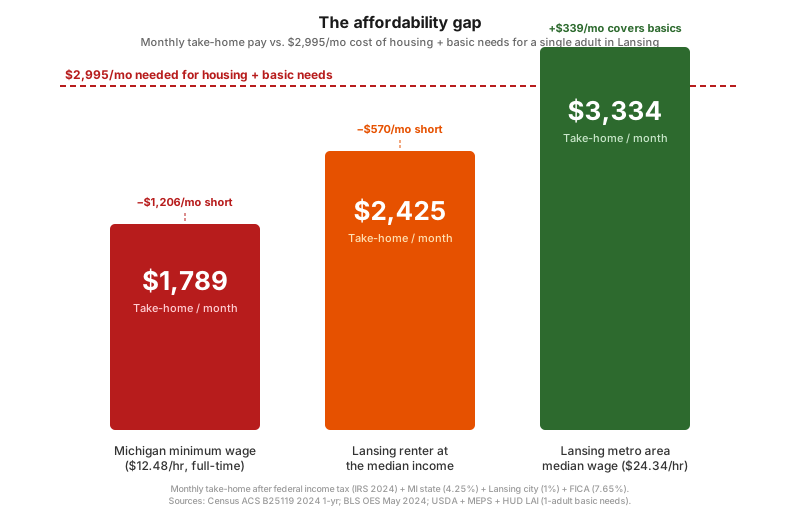
More than half of the 213,610 workers in the Lansing-East Lansing metro area earn less than $24.34 per hour. A single adult needs at least $21.74 per hour to cover housing and basic needs in Lansing; a couple needs $30.30; a family with children needs $40 or more. The metro median wage clears the single-adult threshold but falls short for any household with a second adult or children.
The acceleration
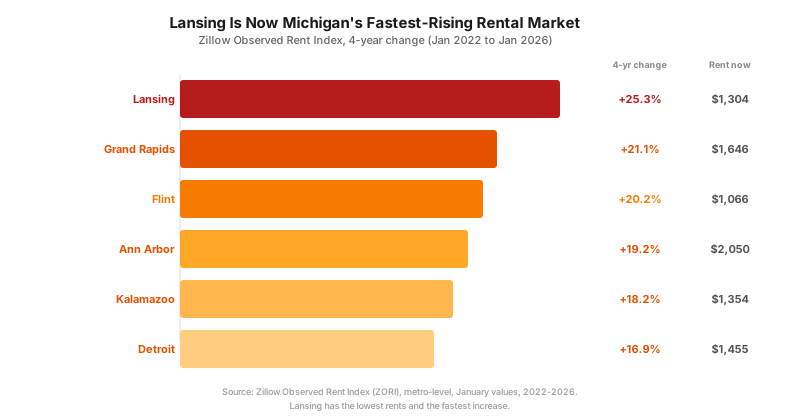
Lansing's rents grew below the state average for years, but that changed around 2022 when Lansing became the fastest-rising rental market in Michigan.
| Metro | Jan 2022 | Jan 2026 | 4-Year Change |
|---|---|---|---|
| Lansing | $1,041 | $1,304 | +25.3% |
| Grand Rapids | $1,359 | $1,646 | +21.1% |
| Ann Arbor | $1,720 | $2,050 | +19.2% |
| Kalamazoo | $1,145 | $1,354 | +18.2% |
| Detroit | $1,245 | $1,455 | +16.9% |
Source: Zillow Observed Rent Index, metro-level, January values.
The increases are not evenly distributed across the city. Three Lansing ZIP codes saw double-digit annual rent increases in 2026: 48911 in South Lansing (+11.4%), 48912 on the Eastside (+11.4%), and 48906 in North Lansing (+10.3%). South Lansing has the lowest rents in the metro at $1,067 per month, which means the fastest increases are landing in the neighborhoods where residents have the least room to absorb them.
HUD's Fair Market Rent for Ingham County jumped 12.5% in a single year (FY2025 to FY2026), the sharpest spike of any peer county. When HUD's own methodology detects a surge that large, it is confirming what renters already know.
The burden
51.8%of Lansing renters are cost-burdened by the federal 30% standard, which understates the actual share who cannot cover basic needsCensus ACS B25070, City of Lansing, 2024. 11,555 of 22,300 renter households.25.6%are severely cost-burdened, paying more than half their income just on rent, before transportation, food, or anything elseCensus ACS B25070, City of Lansing, 2024. 5,700 renter households.648people were homeless in the Lansing/Ingham County area on a single night in January 2024, including 134 childrenHUD MI-508 Point-in-Time Count, Jan 30, 2024900+properties are currently red-tagged or pink-tagged for code violations in LansingWILX, Feb 26, 2026
By the federal 30% standard, more than one in two Lansing renters is cost-burdened, and one in four pays more than half their income on rent alone. But rent is only one bill. When you add in a car, food, a doctor, and the electric bill, a single adult needs $45,214 a year to cover basics, a childless couple needs $63,026, and a single-parent family with two children needs up to $95,596, while the median Lansing renter household income is only $36,114. The affordable housing that does exist is 98% occupied, with waitlists that open once every 10 months for a five-day window. When the Lansing Housing Commission last opened applications, 2,800 people applied in five days and were lotteried down to 600.
Who owns the housing
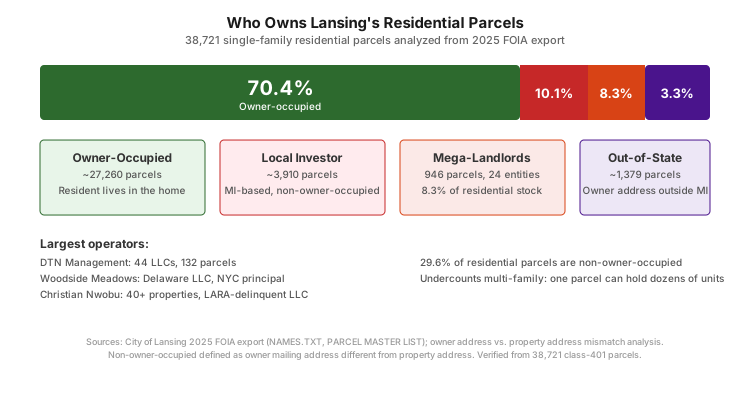
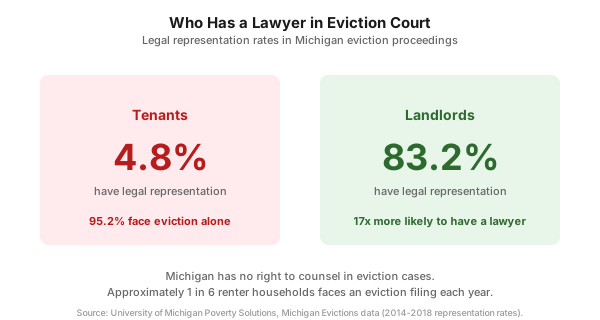
47.1%of Lansing households rent their home. 23,635 of 50,209 total households are renter-occupied; the remaining 52.9% own.Census ACS B25003, City of Lansing, 202424mega-landlords control 946 parcels (8.3% of residential stock)BS&A parcel analysis, 2025 FOIA export3.3%of parcels owned from out of stateBS&A owner address analysis, 20254.8%of tenants have legal representation in eviction proceedings. 83.2% of landlords do.U of M Poverty Solutions
Nearly a third of Lansing's residential parcels are owned by someone who does not live in them. The largest operators manage dozens of LLCs across multiple states, making code enforcement and accountability difficult. When a tenant in one of these properties faces eviction, there is a 95% chance they will not have a lawyer, while the landlord almost certainly will.
What is being done
Ingham County voters passed a housing and homelessness millage in November 2024, generating $5.6 million per year for four years. The city purchased 50 ModPod units for $645,000 as transitional housing for people who are unhoused. The Lansing Housing Commission has 111 new affordable units under construction, the first new LHC construction in 20 years, with 50 additional senior units planned in REO Town.
The state has a goal of 115,000 new units and has created roughly 84,000 so far. Governor Whitmer proposed $2 billion for affordable housing in 2025. Bipartisan legislation introduced in February 2026 would allow duplexes in single-family zones and reduce parking requirements.
These are responses to a crisis that has been building for years. Whether they are proportional to the scale of the problem depends on how you read the numbers above. Michigan is still short 195,462 rental homes affordable to its lowest-income renters. In Lansing, the housing availability rate is 3.1%, below the 5% threshold economists consider healthy, with 2,501 housing units sitting off-market entirely and affordable housing running at 98% occupancy with a waitlist measured in years.
Who benefits from a housing market this tight, and who in city government is responsible for the policies that produced it?
Part 2: Homeowners covers the other side of the crisis: the highest property tax rate in Ingham County, assessment regressivity, and what it takes to buy and sustain a home in Lansing today.
Methodology and data vintages
Numbers in this post come from multiple sources with different release dates. Income and housing use the 2024 1-year American Community Survey for the City of Lansing, the most recent Census release (September 2025). Basic-needs cost components come from federal authoritative sources: food from the USDA Low-Cost Food Plan (October 2024), housing from ACS B25031 Lansing city median gross rent by bedroom count (2024), transportation from the HUD Location Affordability Index for Lansing city census tracts, medical from MEPS (Midwest region), childcare from Michigan DHHS Ingham County 2024 market rate survey, internet/mobile from the BLS Consumer Expenditure Survey (2023), and a standard 10–15% miscellaneous buffer for other necessities (per MIT Living Wage and ALICE conventions). Taxes model federal income tax (IRS 2024 brackets, standard deduction, Child Tax Credit, EITC) plus Michigan state (4.25%), Lansing city (1.0%), and FICA (7.65%).
The income thresholds in the composition table are computed per composition. The stacked income histograms use Census B25118 income totals for the City of Lansing (place 46000) and composition shares derived from ACS PUMS 2024 1-year microdata for Public Use Microdata Area 01801 (southern and eastern Ingham County, the closest geographic proxy to the City of Lansing available in PUMS). PUMA 01801 covers approximately the south half of Ingham County including most of Lansing city plus nearby suburbs. PUMS composition proportions within each income bucket are rescaled to match the Lansing city income totals, preserving composition patterns while anchoring to Lansing-city absolute counts.
ALICE data covers 2023, published in the 2025 ALICE Report. Zillow market rent is January 2026. The 2024 1-year ACS has higher margins of error than the 5-year estimates but reflects current conditions more accurately.
Sources
NLIHC Out of Reach 2025 (Michigan). Census ACS B25070 (renter cost burden, City of Lansing, 2024). Census ACS B25119 (renter income, City of Lansing, 2024). Census ACS B25064 (median gross rent, City of Lansing, 2024). Census ACS B25004 (vacancy, City of Lansing, 2024). Zillow Observed Rent Index (metro and ZIP, January 2022-2026). HUD Fair Market Rents (FY2024-2026). BLS Occupational Employment and Wage Statistics (Lansing-East Lansing MSA, May 2024). HUD Location Affordability Index (34 Lansing city tracts). MIT Living Wage Calculator (Ingham County, MI). USDA Cost of Food at Home (October 2024 Low-Cost Plan). AHRQ MEPS (Medical Expenditure Panel Survey). BLS Consumer Expenditure Survey. HUD MI-508 Point-in-Time Count (Jan 30, 2024). U of M Poverty Solutions (eviction data). BS&A Online and City of Lansing FOIA export (parcel data, 2025). Detroit News (Feb 22, 2026, rent acceleration). WILX (Feb 26, 2026, 900+ tagged properties). City Pulse (affordable housing occupancy, waitlist). National Housing Crisis Task Force (Ingham County millage). NLIHC Michigan Housing Profile (195,462-unit shortage). Brooke Amendment (1969). Housing and Community Development Amendments (1981). Harvard JCHS (2018, 30% standard assessment). Michael Stone (residual income approach). Matthew Desmond, Evicted.
More from Housing
All Housing →
Public Housing Commission Conflict-of-Interest Standards
Rhinoceros NewsroomApr 26, 2026
Federal and Michigan rules that govern conflicts of interest on a public housing commission cluster around four authorities: HUD's mixed-finance development standard at 24 CFR §905.604, the federal-award procurement standard at 2 CFR §200.318(c), Michigan's public officer conflict statute at MCL 15.321 et seq., and the Lansing Housing Commission's own bylaws. Each rule names a specific prohibited conduct, a required disclosure or recusal, and a specific body authorized to act when conditions covered by the rule appear in the public record. HUD's Office of Public Housing Investments (working through the HUD Detroit Field Office for Michigan) and the Michigan Attorney General's Public Integrity Unit hold the federal and state authority respectively.

What Is the Lansing Housing Commission?
Rhinoceros NewsroomApr 26, 2026
The Lansing Housing Commission is the City of Lansing's public housing authority, chartered in 1964 under MCL 125.651 and governed by a five-member volunteer board appointed by the Mayor. As of 2025 LHC operates 66 public-housing units (down from 833 in 2020), administers 2,252 federal Section 8 vouchers and 253 project-based vouchers, and acts as development partner on a Low-Income Housing Tax Credit pipeline of more than $200 million in active project cost. Three of the people sitting in LHC's governance hold paid positions at organizations that earn fees from LHC's deals: Board Chair Emma Henry at Capital Area Housing Partnership ($123,787/year per its FY2025 IRS Form 990), Commissioner Ashlee Barker at Cinnaire (the standing purchaser of LHC's tax credits), and Executive Director Doug Fleming as agent of the General Partner LLCs collecting developer fees on LHC LIHTC partnerships.

Federal Housing Dollars in Lansing: The Network Around the LHC
Rhinoceros NewsroomApr 26, 2026
Roughly $200 million in federal Low-Income Housing Tax Credits flow through LHC's Lansing-area development pipeline, plus federal voucher subsidies for 2,252 households. The pipeline moves through a small cluster of nonprofit, private, and law-firm entities and a recurring set of individuals who hold multiple roles across them. LHC Board Chair Emma Henry earns $123,787 a year as Executive Director of Capital Area Housing Partnership, the nonprofit named as partner on LHC LIHTC deals her board approves. Commissioner Ashlee Barker is paid Vice President at Cinnaire, the financial institution the LHC executive director identified as the standing purchaser of LHC's tax credits. The 2024 LHC board minutes record one Henry abstention out of fifteen-plus substantive resolutions, and zero Barker recusals across eight 2024 board meetings.